How do you view the Cross?

Recently there was a fictional movie about an assassination. In the film, the story kept starting over from the beginning. Each time it was from a different person’s perspective…interesting thought. Oddly enough, we see the same thing with the crucifixion of Jesus. Consider the scene:

39And those who passed by blasphemed Him, wagging their heads 40and saying, “You who destroy the temple and build it in three days, save Yourself! If You are the Son of God, come down from the cross.” 41Likewise the chief priests also, mocking with the scribes and elders, said, 42“He saved others; Himself He cannot save. If He is the King of Israel, let Him now come down from the cross, and we will believe Him. 43He trusted in God; let Him deliver Him now if He will have Him; for He said, ‘I am the Son of God.’” – Matthew 27:39-50 NKJV

The First View: “The Mockers”

There are always those who know enough to ridicule, but not enough to understand. The comment in verse 43 is a reference to Psalm 22:8

“He trusted in the Lord, let Him rescue him.”

However, they ignored the later verses of the same Psalm (16-18),

“They pierced my hands and my feet; I can count all my bones. They look and stare at me. They divide my garments among them, and for my clothing they cast lots.”

Amazing isn’t it. The truth was right in front of them, but mocking attitudes completely hid the obvious.

The Second View: “The Confused”

These folks were watching, but couldn’t figure out what they were witnessing.

47Some of those who stood there…said, “This Man is calling for Elijah!” 48Immediately one of them ran and took a sponge, filled it with sour wine and put it on a reed, and offered it to Him to drink.”

Often there are people just trying to figure it out. The ones mentioned in verse 47 probably didn’t understand Hebrew and hearing “Eli” jumped to conclusions that Jesus was calling for Elijah. They had heard all about Elijah in the old stories, so maybe they thought, “He’s delirious and calling on Elijah for help.” Of course that wasn’t the case. Their reaction was to Jesus quoting a Psalm…verse 1 of the same Psalm just mentioned (22),

“My God, my God, why have you forsaken me?”

I like to think some of this group eventually “got it”; becoming followers and part of the early church.

The Third View: “The Redeemed”

Since we can look at events surrounding the Cross through the lens of scripture, we have help understanding how it fits together. II Corinthians 5:21 says Jesus became sin for us. For generations, the Hebrew people had symbolically placed their sins on sacrificial animals, but now a worthy sacrifice was positioned to literally bare the sins of the entire world…leading to a crushing transaction:

45Now from the sixth hour until the ninth hour there was darkness over all the land.”

Resulting in:

  • The Transfer – Like a file being downloaded, sin was poured out on the perfect Son of God. For three hours creation grieved in darkness and broke under the strain (earthquakes and stone breaking v.51). Just as Romans 5:8 says, “…while we were still sinners, Christ died for us.”
  • Becoming the Curse – Galatians 3:13 tells us that Christ became cursed in our stead, meaning the hopelessness from trying to keep the Law is gone forever. He satisfied the perfect standard of the Law on our behalf!
  • Open Access – Verse 51 of Matthew 27 describes the temple veil surrounding the Most Holy Place being torn in two. As redeemed children of God we can now enter His presence through Jesus our High Priest (Hebrews 4:14-16).

So what’s your view? I sincerely hope you have trusted Christ, and know His peace. If you do, thankfully share it!

Series: “The Questions of Jesus” – Lesson X

Posted in Uncategorized | Tagged , , , , , , , , , | Leave a comment

The Thought Train

Have you ever said, “Wow, what was I thinking?” You know the routine. You’re in the middle of a personal rock slide or organizational crash and wonder, “How’d I get here?” Well, since transporters only exist in science fiction, we can retrace our steps and get an idea. At that point we have to choose what to do next; learn from it, or simply keep going…bound to repeat the process.

Part of growing as a disciple of Christ is becoming like Him. Over the years, I’ve made plenty of mistakes, and often wondered why. Of course, one reason is because I’m still in a fleshly body and far from perfect, but the other is best described by something Chip Ingram wrote in his book Good to Great in God’s Eyes. Look at this brief excerpt:

“Picture a train if you will. The engine is our thinking, and it pulls the first car of emotions, then the car of behavior, and then the car of consequences. Good thoughts will influence our emotions for good, which in turn will influence our behavior and produce positive consequences. Negative thoughts have the same influence in the opposite direction. What we think will determine the course of our life.” – page 15

Now before you think I’ve been hit over head with some guru’s power-of-positive-thinking textbook, let me clarify. He’s talking about a biblical principle based on passages like this:

8Finally, brethren, whatever things are true, whatever things are noble, whatever things are just, whatever things are pure, whatever things are lovely, whatever things are of good report, if there is any virtue and if there is anything praiseworthymeditate on these things.”  – Phil. 4:8 NKJV

2Do not conform to the pattern of this world, but be transformed by the renewing of your mind. Then you will be able to test and approve what God’s will is-His good, pleasing and perfect will.”Romans 12:2 TNIV

Meditating on such passages will directly affect daily life. Unlike eastern style meditation, which empties the mind, the Bible tells us to think deeply on scripture and be filled with the Holy Spirit (Psalm 119:15-16 & Eph. 5:18). Our thought life matters. It’s really that simple. I often talk to people who want their life to be different, but they’re not willing to think different.

In a recent discussion with some ministry leaders in our church, we identified several practical benefits to the right thinking:

  • Family Life – As the spiritual leader in our home, the right thinking positions me to see my role in the proper perspective. The weight of the responsibility is still there, but what I’m trying to be looks different. It’s not a performance measurement, it’s a character measurement.
  • Goal Setting – In the process of reading, praying, and contemplating, the Holy Spirit can align my thinking with His. I must give up my way of thinking, and pray for His. It’s not complicated, but it does cost and the currency is self-centered, me-oriented pursuits.
  • Protection – The right thinking through Christ brings the peace of God (Phil. 4:7) which guards our hearts from the many pitfalls waiting for restless, anxious attitudes (Phil.4:7). When my mind is busy thinking on the right things, it’s not free to entertain the wrong things.

So I encourage you to find a few minutes today and pray for God’s leadership in your thinking…it sets the tone for everything else.

Below are printable Thought Train Worksheets for personal reflection or group discussion:

Click here for a version of the worksheet to the left (PDF format)

Click here for a version including Phil. 4:8 (PDF format)

Click here for a version including Rom. 12:2 (PDF format)

Posted in Christian Life | Tagged , , , , , , , , , | 1 Comment

When Jesus asks, “What do you wish?”

Describing my heart’s desire has changed over the years. As a kid it revolved around my dirt bike, baseball, or adventure. As a young adult, it shifted to marriage, family and career. Studying Matthew 20 recently prompted a fresh look at the question. Jesus asks in verse 21, “What do you wish?” Take a look:

20Then the mother of Zebedee’s sons came to Him with her sons, kneeling down and asking something from Him. 21And He said to her, “What do you wish?” She said to Him, “Grant that these two sons of mine may sit, one on Your right hand and the other on the left, in Your kingdom.” 22But Jesus answered and said, “You do not know what you ask. Are you able to drink the cup that I am about to drink, and be baptized with the baptism that I am baptized with?” They said to Him, “We are able.”Matthew 20:20-22 NKJV

Before we’re too hard on James and John, let’s remember, they were part of the inner circle along with Peter, invited to witness the magnificent transfiguration earlier. So to them this thing was headed in a direction needing some hierarchy. I probably would have fell into the same thinking. At this point, Jesus steps in and provides job descriptions for Kingdom workers. As a matter of fact, He did several times. So, on one side I have my hopes and dreams…on the other I have what Jesus described as worthy pursuits. Do they match?

Let’s look at three pictures He painted:

The Cross

In Matthew 16:23 (in response to Peter’s urging that Christ would not be killed) He says, “If anyone desires to come after Me, let him deny himself, take up his cross and follow Me.” The cross was not yet a religious symbol. It represented painful death to powerless non-Roman citizens. In other words, shame was inextricably tied to the cross. It was a constant reminder that Rome was in charge. It was not uncommon when approaching a city to see people on crosses for various crimes and rebellion. What does that mean for us now? 

  • We give up our “rights”
  • We identify with Him
  • We choose to glory in Him alone
  • We let go of pride

The Life of a Servant

In Matthew 20:26 after the above conversation, Jesus goes on to say, …whoever desires to be great among you, let him be your servant. The Greek word Matthew used was “diakonos” (the word we get deacon from). As a servant I should aspire to serve. Jesus not only said it, but He modeled it. So what does that mean practically? 

  • It’s considering others better than myself
  • It’s less interest in power & position
  • It’s giving up the pursuit of worldly wealth

The Position of a Steward

Jesus also gives us a contrasting picture in Luke 12 of faithful and unfaithful stewards. In the overall discourse He talks about a different mindset than the world. He said to avoid hypocrisy, worry, trust in wealth, and fear of men. Then He went on to describe the faithful steward (verses 35-48). One who knows his position and thrives in it. The faithful steward is: 

  • Ready for what each day may bring (girded v.35)
  • Anticipating the Masters return (v.37)
  • Diligent in daily tasks (lamps burning v.35)
  • Willing to follow the Master’s plan (v.47)

So, do our dreams match? That’s a tough question. I can honestly say, I’m praying that mine do, but at the same time I confess to being a little fearful while praying. However, it’s what we must pray. As a follower of Christ, I have been charged to do so, and in His strength I can (Phil. 4:13, Gal. 2:20)!

Those are my thoughts, what are yours?

Series: Questions of Jesus – Lesson IX

Posted in Uncategorized | Tagged , , , , , , , , | Leave a comment

Divorcing “Gay” from “Marriage”

Kirk Cameron is drawing fierce criticism for his statements concerning “Gay Marriage” during a Piers Morgan interview on CNN. He said, “Marriage was defined by God a long time ago…and it was defined in the garden between Adam and Eve.” Of course, all of the expected insults are being hurled at him for being “intolerant” and “out-of-step with the culture”.

There is much debate about it, but it’s really not a complicated issue, because the term “Gay Marriage” is an oxymoron…like trying to discuss “dry water”. To let it be framed as a right or wrong question is to agree with the premise that it’s an equal option. It’s not. Kirk was right, we don’t have the privilege to define marriage, God does. He made us “male and female” (Genesis 2:27), and He also pronounced; “a man shall leave his father and mother and be joined to his wife, and they shall become one flesh.” (Genesis 2:24).

As a Christian, you may be thinking, “OK, I get that, but how do I share it and demonstrate the love of Christ too?” I’ve found it helpful to focus on the clear picture described in God’s Word, instead of what it isn’t. In other words, the main point is the beautiful picture of what it can be. God formed Eve specifically to complete Adam. A man and woman fit together in every way. Physically, emotionally, and psychologically, God designed us to compliment each other. It doesn’t take much observation to see how boys and girls are wired different. We augment each other’s weaknesses, and keep one another’s extremes in check. What an amazing process to see two lives merge together into something greater than the sum of two parts.

At the end of the day, the gift of Biblical marriage is far superior to any counterfeit models. Whether it’s same-sex arrangements or “open marriages”, the proven historical value of a traditional home trumps all others. It’s not always easy, but it’s still the best, and worth defending. Thanks Kirk for speaking the truth.

Posted in Christian Life | Tagged , , , , , | 4 Comments

The Christian SWOT Diagram

The original S-W-O-T analysis has been used for years by organizations to identify Strengths, Weaknesses, Opportunities, and Threats. Credited to Albert Humphrey, it’s a great tool for assessment and planning.

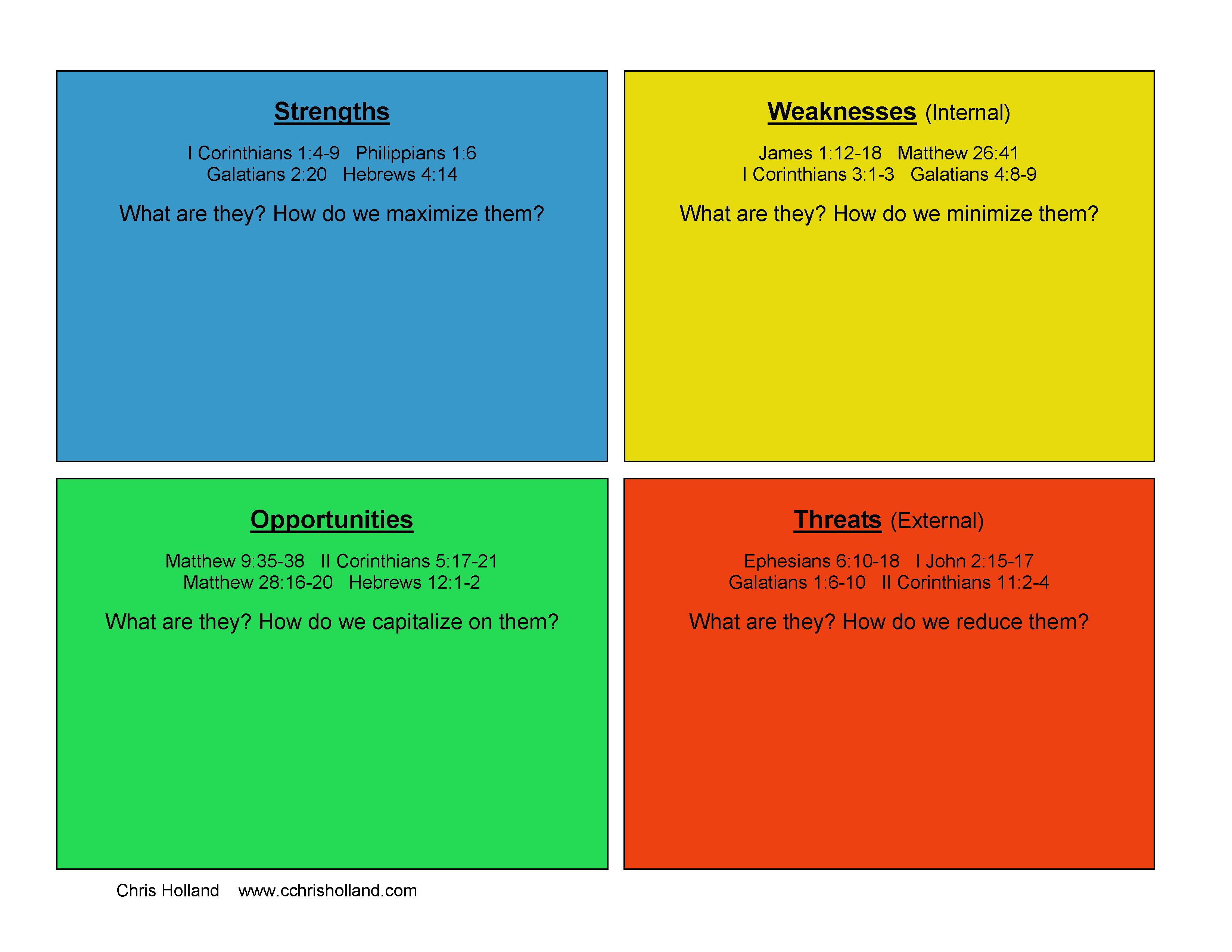
As followers of Christ, we can personally benefit too from identifying these four areas in our life. Through personal inventory, reflection, and/or group discussion, we can discover what the Bible teaches. There are many verses applicable for each section, but I’ve limited mine to four in each. Here’s what a personal grid may look like (click to enlarge):


 The four sections are:

Strengths

I Corinthians 1:4-9, Philippians 1:6, Galatians 2:20, Hebrews 4:14

What are they? How do we maximize them?

Weaknesses (Internal)

James 1:12-18, Matthew 26:41, I Corinthians 3:1-3, Galatians 4:8-9

What are they? How do we minimize them?

Opportunities

Matthew 9:35-38, II Corinthians 5:17-21, Matthew 28:16-20, Hebrews 12:1-2

What are they? How do we capitalize on them?

Threats (External)

Ephesians 6:10-18, I John 2:15-17, Galatians 1:6-10, II Corinthians 11:2-4

What are they? How do we reduce them?

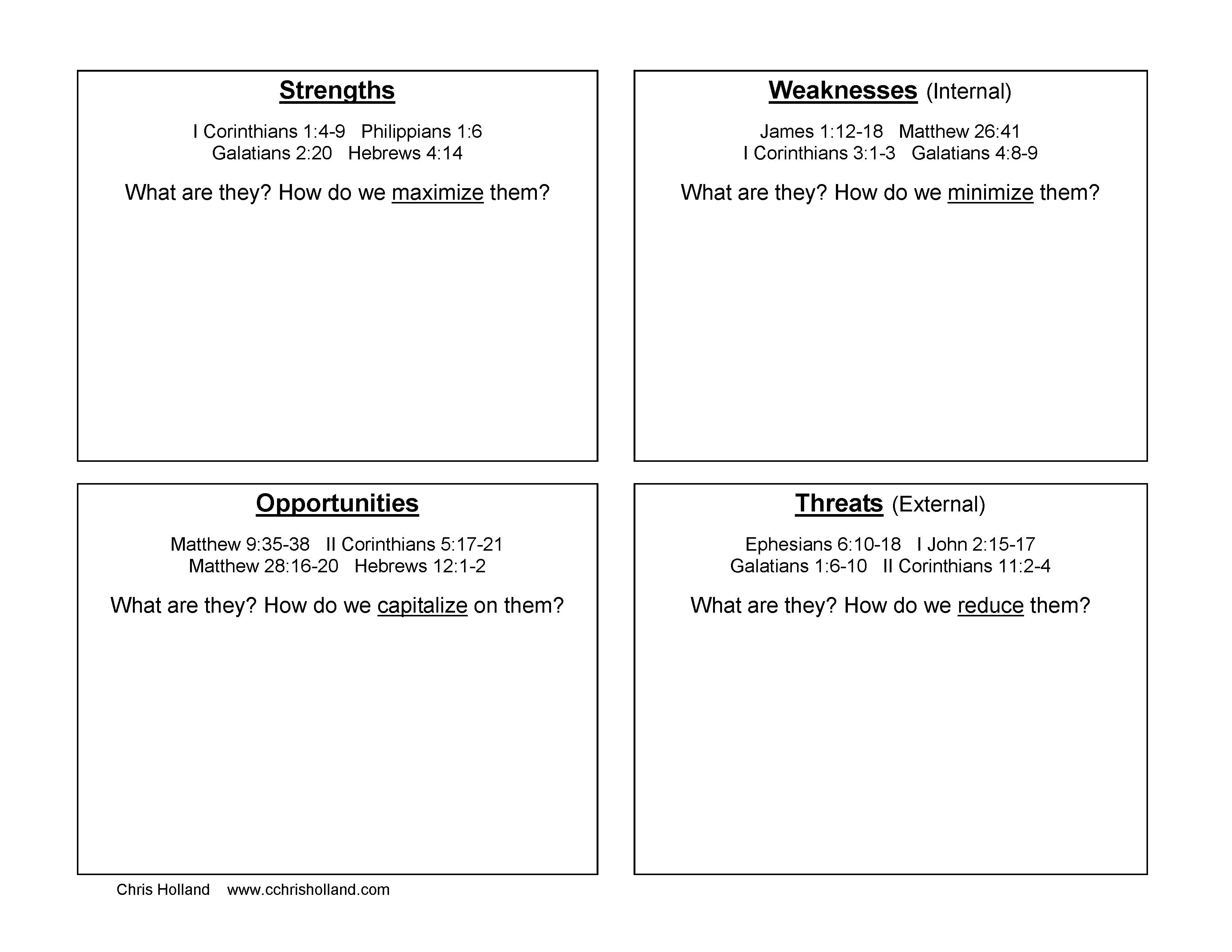
One last note, it’s important to answer the second part. Just like in business, listing the “what” is only valuable when we complete the next step by answering the “how”. How do we maximize…minimize…capitalize and reduce? I encourage you to give it a try and let me know what you think. Below is a black & white version for easy printing:

-ADDITIONAL RESOURCES-

Click here for sample grid (color PDF version):

http://bit.ly/QLephM

Click here for sample grid (black & white PDF version):

http://bit.ly/MuWHrk

“The Thought Train” is another group discussion/personal reflection tool that may be of interest. Click here to read about it: http://bit.ly/OLYrhK

Here’s a fantastic book for personal development or those in your organization:

0801014271

“Good to Great in God’s Eyes” by Chip Ingram – Click here for more info at Amazon

Updated 1/21/13

Posted in Christian Life | Tagged , , , , , , , , , | 4 Comments

Jesus According to Polls

Asking the question, “Who is Jesus?” on the street in most cities would rarely produce a clear consensus. No other name in history equals His influence, but there are still various opinions of Christ. It’s interesting how little that’s changed in 2,000 years. The crowds following Jesus didn’t have a clear answer either. Asking them the same question would probably have gone something like this: 

“Excuse me Jedidiah, who do you think this teacher named Jesus is?”

“Well, I’m not really sure, but they say He’s some kind of new Prophet.” 

As a matter of fact, the scripture demonstrates it:

13When Jesus came into the region of Caesarea Philippi, He asked His disciples, saying, “Who do men say that I, the Son of Man, am?” 14So they said, “Some say John the Baptist, some Elijah, and others Jeremiah or one of the prophets.” 15He said to them, “But who do you say that I am?” 16Simon Peter answered and said, “You are the Christ, the Son of the living God.” 17Jesus answered and said to him, “Blessed are you, Simon Bar-Jonah, for flesh and blood has not revealed this to you, but My Father who is in heaven.”Matthew 16:13-17 NKJV

So yeah, confusion about Christ isn’t exactly breaking news, but understanding it helps us see spiritual conversations in a broader context. Consider three thoughts regarding Jesus’ questions: 

I. Opinions Change

Public Opinion on anything lasts about as long as a 5th grade crush. Everyone aroundPalestine was forming opinions. From political savior to a back-from-the-dead prophet; He was labeled many ways…even theGallup folks would’ve struggled to figure it out. Remember how the crowd went from shouting “Hosanna!” to “Crucify Him!” within a week’s time…wow!

Regardless of method (personal, corporate worship, written word) the gospel has to be received individually, not as a group. Yes, groups of people have heard, and responded, but life-change happens at the personal level. Naturally Jesus knew what people were saying. He wasn’t attempting to be “relevant”…He was setting up a significant teaching moment. 

II. The Question of Questions

Who do YOU say that I am? It really comes down to that…our response in the most personal place of our being? The Bible tells us Jesus not only accepted Peter’s confession, but also explained that God revealed the truth to him. The fact of it not being the result of Peter’s intellectual pursuit helps us know how to pray: 

  • When studying God’s Word, understanding comes by His revealing.
  • Praying for others involves asking the Holy Spirit to reveal truth to them.
  • Sharing Christ includes staying in step with the Holy Spirit, not my own timeline, agenda or motives. 

III. Who does my life say Jesus is? 

Do my spoken words and life match? I’ll be honest, that’s a tough one. Speaking about Christ is one thing, but asking folks around me to describe the Jesus my life communicates is another. What if my co-workers wrote down the characteristics of Jesus based on the language of my life? Worse yet, what if they asked my family? I can’t sing and call him Lord on Sunday, then ignore Him on Monday without it being noticed. 

Thankfully, my relationship with Christ isn’t based on effort, but my effort should be based on my relationship. It’s not about perfection, but authentically living out the truth He’s revealed to me. Jesus by the polls gives mixed results, but a changed life declares the truth of a Savior who we know is the Christ, the Son of the living God!

For a brief overview of the uniqueness of Christ, this post may help:

https://cchrisholland.com/2011/10/10/jesus-among-bumper-stickers/

Series: “The Questions of Jesus” Lesson VII

Posted in Apologetics | Tagged , , , , , , , , | Leave a comment

Shaking up Tradition

It’s hard to beat Ray Stevens’ “The Mississippi Squirrel Revival” when it comes to mocking sanctimonious hypocrisy. The imagery of a traditional setting invites all kinds of opinions. You can view the video here:

http://youtu.be/K16fG1sDagU

Unfortunately, the conversation of how church should look, feel, and operate is more often tied to preference than scripture. So how should we measure “traditions”? Well, Jesus gave us a great example…let’s see how He handled it:

1Then the scribes and Pharisees who were from Jerusalem came to Jesus, saying, 2“Why do Your disciples transgress the tradition of the elders? For they do not wash their hands when they eat bread.” 3He answered and said to them, “Why do you also transgress the commandment of God because of your tradition? 4For God commanded, saying, ‘Honor your father and your mother’;and, ‘He who curses father or mother, let him be put to death.’5But you say, ‘Whoever says to his father or mother, “Whatever profit you might have received from me is a gift to God”— 6then he need not honor his father or mother.’ Thus you have made the commandment of God of no effect by your tradition. 7Hypocrites! Well did Isaiah prophesy about you, saying: 8 ‘These people draw near to Me with their mouth, and honor Me with their lips, but their heart is far from Me. 9 And in vain they worship Me, Teaching as doctrines the commandments of men.’” 10When He had called the multitude to Himself, He said to them, “Hear and understand: 11Not what goes into the mouth defiles a man; but what comes out of the mouth, this defiles a man.” – Matthew 15:1-11 NKJV

Historical Notes:

  • The Law – Moses received the 10 Commandments and much more directly from God. He recorded it in five books – “The Pentateuch”. This was the basis for Jewish laws and customs.
  • The Mishnah – In addition to the Law, there were many oral traditions that rabbis put into formal teaching and requirements. This is what Jesus’ disciples were accused of transgressing.
  • Hand Washing – The issue here was ceremony, not hygiene. Mark’s account (Mark 7) even goes into some detail.
  • Corban – Setting aside assets as a “gift to God”, thereby rendering it not usable for taking care of aging parents, or similar things.

The Accusation

The Jewish leaders questioned Jesus, “Why do Your disciples transgress the tradition of the elders?” (v.2) Here are two thoughts regarding their words:

  • They assumed “tradition” was at a level where violation was a “transgression”. In modern times, we often get confused too identifying what’s tradition and what’s from scripture.
  • There is no reference in the gospels (that I can find) where the Jewish leadership ever took Jesus’ teaching to God in earnest prayer to seek His guidance. How much of a difference that would have made, and could make in our current church environment.

Jesus’ Response

Jesus didn’t seem interested in debate over details of hand washing. However, He did take charge of the conversation and point out two things:

  • He redirected their attention back through the complex “stuff” of Jewish life to highlight one of the original 10 commandments being broken. Here they were mad about a violation of men’s instructions, while rejecting God’s instruction! (Mark 7:6-9)
  • He identified that it was not only of questionable value (Corban); it was specifically causing a commandment to broken. (v.3)

Summary

According to Jesus in Matthew 15:18, the heart is what defiles. Motives are always where we should be looking, not necessarily the practice. When evaluating a “tradition”, we should be asking questions like, “Does this activity further the Kingdom?” or “Who gets the glory from this event?”

There are a lot of traditions in church life. As a believer, we need to be able to look at scripture, pray through what it says, and then be submissive to God’s lead. Think about these examples:

  • The Lord’s Supper: We’re commanded to observe it (as an ordinance), but the choices of cups and linens are not
  • Christmas Eve Service: Corporate worship is commanded, but specifically on December 24 is not
  • Music: Worshipping through song is commanded, but the publisher and melody is not

You get the picture. These are wonderful God given activities, but personal preferences can overshadow important truths. At the end of the day, it’s really not about you or me. The real concern isn’t how the past was or what the hipsters across town prefer; it’s about what the Bible says. So when discussions arise over practices; filter it through God’s word (including attitudes) and then make a decision. It sounds like the right place to start to me!

Series: “The Questions of Jesus” – Lesson VII

Posted in Uncategorized | Tagged , , , , , , , , | 2 Comments

Spiritual Road Rash

I have a scar on my right knee. As a matter of fact, I have several life-long souvenirs from up close encounters with the pavement via bikes, skateboards, etc. Spiritually speaking I also have similar reminders, but thankfully, following those over-the-handle-bars wipeouts, Jesus picked me up, dusted me off, and bandaged me up. The tough part was when He brought the bike back over and asked me to “Get back on.” Oswald Chambers said it so powerfully in the following devotion. It reminded me of our Lord’s incredible grace, take a look:

2/18 Devotional – Rise, let us be going —Matthew 26:46

In the Garden of Gethsemane, the disciples went to sleep when they should have stayed awake, and once they realized what they had done it produced despair. The sense of having done something irreversible tends to make us despair. We say, “Well, it’s all over and ruined now; what’s the point in trying anymore.” If we think this kind of despair is an exception, we are mistaken. It is a very ordinary human experience. Whenever we realize we have not taken advantage of a magnificent opportunity, we are apt to sink into despair. But Jesus comes and lovingly says to us, in essence, “Sleep on now. That opportunity is lost forever and you can’t change that. But get up, and let’s go on to the next thing.” In other words, let the past sleep, but let it sleep in the sweet embrace of Christ, and let us go on into the invincible future with Him.

There will be experiences like this in each of our lives. We will have times of despair caused by real events in our lives, and we will be unable to lift ourselves out of them. The disciples, in this instance, had done a downright unthinkable thing— they had gone to sleep instead of watching with Jesus. But our Lord came to them taking the spiritual initiative against their despair and said, in effect, “Get up, and do the next thing.” If we are inspired by God, what is the next thing? It is to trust Him absolutely and to pray on the basis of His redemption.

Never let the sense of past failure defeat your next step.

By Oswald Chambers

http://utmost.org/


Posted in Christian Life | Tagged , , , , , , | Leave a comment

10 Great Bible Study Questions

When studying a Bible passage, consider starting with these great questions I recently heard:

  1. What stands out about it?
  2. Is there anything you don’t like about it (makes you uncomfortable)?
  3. Is there anything about it you don’t understand?
  4. Is there a sin to avoid?
  5. Is there a command to obey?
  6. Is there a promise to claim?
  7. Is there an example to follow?
  8. What does it say about us?
  9. What does it say about God?
  10. How should my life/the church change as a result of studying it?

Of course, prayer should be part of studying scripture; praying specifically for the Holy Spirit to “guide into all truth” (John 16:13). Commentaries and Christian authors are great helps (I use them regularly), but only the Bible is God’s Word (and always relevant).  

(Thanks to Rando Acres for passing on this list…good stuff!)  


Posted in Uncategorized | Tagged , , , , , | Leave a comment

Is it a Test or Temptation?

Often, a dilemma contains both; a test and a temptation. The trick of course is to identify one from the other. Let’s explore it by looking at a familiar story: 

5Then Jesus lifted up His eyes, and seeing a great multitude coming toward Him, He said to Philip, “Where shall we buy bread, that these may eat?” 6But this He said to test him, for He Himself knew what He would do. 7Philip answered Him, “Two hundred denarii worth of bread is not sufficient for them, that every one of them may have a little.” 8One of His disciples, Andrew, Simon Peter’s brother, said to Him, 9“There is a lad here who has five barley loaves and two small fish, but what are they among so many?” 10Then Jesus said, “Make the people sit down.” Now there was much grass in the place. So the men sat down, in number about five thousand. 11And Jesus took the loaves, and when He had given thanks He distributed them to the disciples, and the disciples to those sitting down; and likewise of the fish, as much as they wanted. 12So when they were filled, He said to His disciples, “Gather up the fragments that remain, so that nothing is lost.” 13Therefore they gathered them up and filled twelve baskets with the fragments…”John 6:5-13 NKJV

First – two helpful ground rules concerning testing and temptation: 

  • God NEVER tempts. James 1:13 declares, “…God cannot be tempted by evil, nor  does He Himself tempt anyone.”. The next verse (14) then explains “we’re drawn away by our own desires.”
  • God DOES test. The scripture describes many occasions where God administers tests, but consider this timely quote; “The nature of a test depends on the intent of the person conducting it.” – Charles Swindoll commenting on John 6

Second, here are two observations from the test given to Philip and the other disciples.

I. Jesus Highlighted the Obvious

“Where shall we buy bread that these may eat?” (v. 5) The story reveals four options before them: 

  • Send the crowd away (what they first approached Jesus with) and get rid of the problem
  • Buy what food they could acquire themselves (a little bit for each, per Philip’s comment)
  • See if the people could pool their resources and cover the need (Jesus actually instructs the disciples to see what the crowd had – Mark 6:38)
  • The unknown – For whatever reasons the disciples didn’t consider option four. This is the “God option”. The one where we’re “out-of-options” and Jesus was helping them to see the contrast.

 II. Jesus Highlighted God’s Provision

The significance of this miracle is made clear by being included in all 4 gospels. Many miracles are in one, two, or three accounts, but all include this one. Not only is how He fed them important, it’s good to notice the process: 

  • He gave thanks – His actions always centered attention on the Father
  • He gave no description of what was coming – imagine the awkward moment when He put the little dinky lunch in front of everyone and prayed. They were probably peeking at each other during the prayer and shrugging their shoulders.
  • His hands touched all the food – how awesome of a thought; it all passed through Jesus’ personal touch!
  • He provided even more than hoped for – The story starts with no hope of covering the need (send them away), then moves to partially covering the need (buying small amounts for everyone), and ends up covering the need and more (enough leftovers to feed the disciples for 2-3 days).

So what does this mean for us? That’s a good question, thanks for asking. It means option four can be a great thing…an entrance exam of sorts to the next level of teaching from the Master. Hey, I’m not gonna lie. I would probably have been right there with Philip trying to cover the need with practical solutions, but thankfully Jesus is still patiently teaching.

If you’re out of options today, give up trying to work it out on your own and let God handle it. Let go and watch. His love is more than we can comprehend and He provides exceedingly, abundantly more than we ask or think (Eph. 314-21). Sometimes giving up a little, can result in a lot!

Series: “The Questions of Jesus” – Lesson VI

Posted in Uncategorized | Tagged , , , , , , , , | Leave a comment

Beyond Stained Glass

I confess. During worship services as a kid, there were moments of day-dreaming (all spiritual of course). In my mind, there were endless amounts of exciting things happening on the other side of those stained glass windows. Right past the barrier of the big blue Noah’s ark, was a game of football. It was just in my mind of course, because you really can’t see through stained glass. I really didn’t know what was on the other side at that moment, but I imagined a lot and it always reflected my interests.

When describing God, the temptation is to patch together bits of color taken from scripture and create a picture we’re comfortable with. If we’re not careful, the result is an image with warm light, but little insight to His true nature. Such was the case with the leaders in John 5. The on-going tension between Jewish leaders and Jesus concerning His credibility was strong. Jesus presented 5 witnesses to corroborate His authenticity (only two were needed under Jewish law), while also asking two questions…take a look:

31“If I bear witness of Myself, My witness is not true. 32There is another who bears witness of Me, and I know that the witness which He witnesses of Me is true. 33You have sent to John, and he has borne witness to the truth. 34Yet I do not receive testimony from man, but I say these things that you may be saved. 35He was the burning and shining lamp, and you were willing for a time to rejoice in his light. 36But I have a greater witness than John’s; for the works which the Father has given Me to finish—the very works that I do—bear witness of Me, that the Father has sent Me. 37And the Father Himself, who sent Me, has testified of Me. You have neither heard His voice at any time, nor seen His form. 38But you do not have His word abiding in you, because whom He sent, Him you do not believe. 39You search the Scriptures, for in them you think you have eternal life; and these are they which testify of Me. 40But you are not willing to come to Me that you may have life. 41“I do not receive honor from men. 42But I know you, that you do not have the love of God in you. 43I have come in My Father’s name, and you do not receive Me; if another comes in his own name, him you will receive. 44How can you believe, who receive honor from one another, and do not seek the honor that comes from the only God? 45Do not think that I shall accuse you to the Father; there is one who accuses you—Moses, in whom you trust. 46For if you believed Moses, you would believe Me; for he wrote about Me. 47But if you do not believe his writings, how will you believe My words?” – John 5:31-47 NKJV

The five witnesses:

  • John the Baptizer (5:32-35)
  • The miracles (5:36)
  • God the Father (5:37)
  • The Holy Scripture (5:39)
  • Moses (5:46)

The two questions:

  • “How can you believe, who receive honor from one another, and do not seek the honor that comes from the only God?” (v.44)
  • “But if you do not believe his (Moses) writings, how will you believe my words?” (v.47)

These verses revealed two things the leaders weren’t willing to give up:

I. Predetermined Reality

(They had already mapped out a detailed itinerary of the Messiah’s mission)

  • Jesus didn’t fit the template – In John 5:35 Jesus said they were willing “for a time” to rejoice with John the Baptizer’s preaching of repentance, but once John’s Messiah (Jesus) deviated from the plan, He was deemed an imposter. They were only ready to follow a “David type” physical King.
  • God versus god – What’s the difference in g-o-d with a capital “G” versus little “g”? It’s the real true God of scripture compared to all other man-made creations. The Jewish leadership had chosen to trade worship of the true indescribable God, to a lesser idea. It was a stained glass idea of Him…predictable…limited…with a value system reflecting their own. 

II. Perception over Substance

John 12:37-43 tells of many leaders believing, but then abandoning Jesus because of the Pharisees. Verse 43 says they caved to the pressure because “they loved the praise of men more than the praise of God.” Whoa, I had to read that one again. Immediately I wondered, “What were they scared to lose?”

  • Position?
  • Friends?
  • Status?
  • Credibility?

It was probably all of the above and maybe more. My prayer today is that those very same fears don’t limit my view of God. His incredible nature is beyond mortal description, but thankfully He has revealed himself to us in His Word. He also personally came in the form of a man, demonstrating His nature, and doing what was most important to Him…redeeming us!

In summary, the most striking point is that the leaders possessed the writings describing Jesus, but still missed Him. In verses 39-40 of John 5, Jesus said they “searched the scriptures”, but weren’t willing to come to Him. So remember as you study…the scripture is God’s revelation of Himself, so only He can fill in the blanks!

Series: “Questions of Jesus” – Lesson V

Posted in Uncategorized | Tagged , , , , , , , , , | Leave a comment

Calling Fire from Heaven

Admit it. In the face of contemporary moral decline and agenda driven news, this thought has crossed your mind:

“A little fire from heaven about now would make believers out of these people!”

Well, you probably haven’t, but I admit I have. I’m not proud of it, but there was just something about the rejection of truth that was frustrating me…and then it happened.

While reading scripture the other day, I suddenly saw myself right in the middle of Luke 9:54-56. Ouch! Without realizing it, a self-righteousness attitude has caused me to see some national leaders as the enemy and not as Jesus sees them. Take a look at the Luke passage:

52…And as they went, they entered a village of the Samaritans, to prepare for Him.  53But they did not receive Him, because His face was set for the journey to Jerusalem.  54And when His disciples James and John saw this, they said, “Lord, do You want us to command fire to come down from heaven and consume them, £just as Elijah did?” 55But He turned and rebuked them, and said, “You do not know what manner of spirit you are of.  56£For the Son of Man did not come to destroy men’s lives but to save them.” And they went to another village. – Luke 9:51-56 NKJV

The disciples saw the village’s rejection of Christ as a reason for destruction, but Jesus firmly corrected their mistake. I doubt they ever asked that question again!

It’s so easy to forget who our real enemy is. It’s not the ones peddling wrong ideas or philosophy; it’s the one who’s behind them. It’s not lost people, it’s the devil. Yes, devastating consequences do come from rejecting Christ, but that should fuel my prayers all the more on their behalf.

I don’t know about you, but I’ve had to pause and ask for forgiveness. The next time you hear or read someone speaking against our Lord’s teaching, remember, “He didn’t come to destroy men’s lives, He came to save.”

Pray for them…you may be the only one who does. Who knows, it may even lead to a chance to share the “reason for the hope that is in you.” (I Peter 3:15)

Posted in Christian Life | Tagged , , , , , , , | Leave a comment

Does God Care?

Relationships, health, career, parenting…life can be FULL of fears. When we least expect it, confidence can get mushy as the clouds gather. So it was with the disciples in Mark 4. Remember the story…
35On the same day, when evening had come, He said to them, “Let us cross over to the other side.”  36Now when they had left the multitude, they took Him along in the boat as He was. And other little boats were also with Him.  37And a great windstorm arose, and the waves beat into the boat, so that it was already filling.  38But He was in the stern, asleep on a pillow. And they awoke Him and said to Him, “Teacher, do You not care that we are perishing?”  39Then He arose and rebuked the wind, and said to the sea, “Peace, be still!” And the wind ceased and there was a great calm.  40But He said to them, “Why are you so fearful? How is it that you have no faith?”  41And they feared exceedingly, and said to one another, “Who can this be, that even the wind and the sea obey Him!”Mark 4:35-41 (NKJV)

Jesus asked two important questions: 

  • “Why are you so fearful?”
  • “How is it that you have no faith?”

Of course, the massive storm beating down comes to mind as having a little something to do with the fear, but Jesus was looking deeper. He was using an incredible teaching moment to grow their faith. Observe the focuses revealed in their question.

I. “We are perishing” (v.38)

We jump to conclusions. I don’t know exactly why. Maybe somebody with a lot of letters behind their name, round glasses and a German accent could tell us, but the truth is…we do. Our focus becomes fixed on the end, and usually the worst case scenario. They were confident of doom, and having Jesus in the boat obviously didn’t change that.

Jesus asked, “Why are you so fearful?” There are two thoughts I know would tempt me:

  •  The size of the storm (the problem is inescapable)
  • Uniqueness of the storm (no one else has ever faced this)

Unfortunately, with my focus on the conclusions, I can’t see the calm Jesus…relaxed and sleeping. Maybe a look over in His direction would give me the confidence I need and encourage my spirit. Next is the second focus we observe.

II. “Do you not care?” (v.38)

Why do we perceive God that way? When life presses in, it can seem as if God doesn’t care. Maybe at some point you’ve thought one of these (you fill in the blank): 

  • “He cares more for ___________ than me”
  • “My circumstances aren’t as important to Him as ___________”
  • “I know He’s able, but _____________”

The disciples knew exactly where Jesus was, and that He’d initiated the journey “Let us cross over to the other side.” (v.35), but their focus was on what He was not doing, not His calm confidence. 

“Peace, be still!” what great words to hear in the midst of a storm. He still speaks, and still cares. 1 Corinthians 10:12-14 says:

“No temptation has overtaken you except such as is common to man; but God is faithful, who will not allow you to be tempted beyond what you are able, but with the temptation will also make the way of escape, that you may be able to bear it.” – NKJV

Take special note of those words in the middle of the quote, “God is faithful”. I don’t know what you may be going through today, but God does. Focus on Him. The storm may be big, dark, and loud, but when He speaks…it changes everything! 

Series – “The Questions of Jesus” – Lesson IV

Posted in Uncategorized | Tagged , , , , , , , | 4 Comments

Who’s the Real Deal?

Years ago, there was a Christian comedian with a very dramatic testimony of being delivered from Satanism. He was funny, told incredible stories, and I was a fan. Unfortunately, one day the truth came out how he’d fabricated most of his story, and quickly fell from the spotlight. Yeah…you’ve probably known similar stories of less than truthful showmen. So how do we know? How do we know who’s for real?

Well, obviously the Lord is the only one who knows hearts, but the Bible gives great instruction concerning authenticity. Let’s consider:

15“Beware of false prophets, who come to you in sheep’s clothing, but inwardly they are ravenous wolves. 16You will know them by their fruits. Do men gather grapes from thornbushes or figs from thistles? 17Even so, every good tree bears good fruit, but a bad tree bears bad fruit. 18A good tree cannot bear bad fruit, nor can a bad tree bear good fruit. 19Every tree that does not bear good fruit is cut down and thrown into the fire. 20Therefore by their fruits you will know them. – Matthew 7:15-20 ( NKJV )

I. Be Careful

  • There ARE false prophets out there. Not only was it true then, but now too. Don’t be eager to lay your Bible aside for someone’s books or podcasts. Our devotion should be to Christ, not a fellow servant.
  • God’s view is clear. I Samuel 16:7 says He looks at the heart and not outward appearance. The inward part is the motivation, and should reflect a changed life by the power of Christ’s redemptive work (the fruit of their life will tell).

II. Be Observant

  • There’s no neutrality. Verses 17-18 say there will be fruit, either good or bad. What’s more, a tree can ultimately only bear after its kind. How much do you know about the people spiritually influencing you right now? Have you really watched their life, and listened close to their teachings?
  • What standard do we use? Galatians 5:22-25 is a great place to start, and Colossians chapter 3 helps us too, by describing an authentic follower of Christ “putting off” the old & “putting on” the new. Combined together, the Fruit of the Spirit (Galatians) and the new life in Christ (Colossians) paints the picture of a self-less person, interested in God’s value system, not the world’s.
  • Individuals AND ministries should both reflect the same values described in those passages. Ministries have personalities, and they should be selfless, just as the man of God should be.

III. Be Patient

  • Time will tell. Relax and let God be the one who validates people. Don’t let outward charisma (or lack of it) cloud your judgment. Pray for discernment and clear direction when choosing a leader or influencer in your spiritual journey. The Bible is our true measure, and a real person of God bases his/her teachings on it.
  • At the same time, we can’t worry about the ones spreading falsehoods. Yes we are to contend for the truth, but in the end God will take care of those peddling false teachings. Being cut down and thrown into the fire is powerful, but we aren’t the axe swingers. Look to Christ for how to respond through the Holy Spirit when dealing with such.

Personalities can be powerful, but never let them over-shadow the fruit!

Series – “The Questions of Jesus” – Lesson III

Posted in Uncategorized | Tagged , , , , , , , , | Leave a comment

Ever Felt Judged?

Most of us have, and of course it’s not exactly a warm-fuzzy feeling. Worse yet, most of us have also been the one to judge others at some point. In Matthew 7, Jesus discusses judging. He directs us to the subject, then asks, “Why do you look at the speck in your brother’s eye, but do not consider the plank in your own eye?” Yep, the old speck & plank, but the great news…Jesus also gives us instructions on how to avoid the plank (and the soreness that goes with it).

Let’s take a look:

1. “Judge not, that you be not judged2. For with what judgment you judge, you will be judged; and with the measure you use, it will be measured back to you. 3. And why do you look at the speck in your brother’s eye, but do not consider the plank in your own eye? 4. Or how can you say to your brother, ‘Let me remove the speck from your eye’; and look, a plank is in your own eye? 5. Hypocrite! First remove the plank from your own eye, and then you will see clearly to remove the speck from your brother’s eye.  6. “Do not give what is holy to the dogs; nor cast your pearls before swine, lest they trample them under their feet, and turn and tear you in pieces. 7. “Ask, and it will be given to you; seek, and you will find; knock, and it will be opened to you. 8. For everyone who asks receives, and he who seeks finds, and to him who knocks it will be opened. 9. Or what man is there among you who, if his son asks for bread, will give him a stone? 10. Or if he asks for a fish, will he give him a serpent? 11.  If you then, being evil, know how to give good gifts to your children, how much more will your Father who is in heaven give good things to those who ask Him! 12. Therefore, whatever you want men to do to you, do also to them, for this is the Law and the Prophets.      – Matthew 7:1-12 NKJV

Before we look at the positive action steps, let’s list the three “don’t” items.

  • Don’t judge v.1
  • Don’t be a hypocrite v.5
  • Don’t waste treasures v.6

Next, what’s the key verse in this passage? Well, anytime I see a “therefore” it’s usually a good clue – and verse 12 is our key, “whatever you want men to do to you, do also to them”. Verse 12 speaks of motive. It ties verses 1-11 all together, revealing a process of verses 7-11 actually facilitating avoidance of 1-6.

A. Don’t Judge

Process Part 1: Asking and receiving – if I ask the Lord for the right view of circumstances then I’ll receive clarity concerning myself and others. In light of Verse 1, I must be concerned with how I’ll ultimately be judged by Christ in following Him, and others view (or judgment) of me. You may say, “It’s not fair for others to judge me.” It’s not, but life isn’t fair, so get over it, they do. My responsibility is to be authentic when they do.

B. Don’t be a Hypocrite

Process Part 2: Seeking and finding – Seek out the precious truths of scripture and how they apply. When I begin to find the depth of what the Bible says about living life as a believer then I’m no longer content with the shallowness of immaturity. At that point, God-led introspection comes and life begins to take on a sense of maturity. Conversely, I don’t want to be hung up on introspection, becoming spiritually paralyzed. Keep moving. When the Lord reveals things, act on it. Remember, the point of verse 5 isn’t to cease “looking” at others, but to see “clearly” when doing so.

C. Don’t Waste Treasure

Process Part 3: Knocking and Opening – Proverbs 9:7-8 says to be careful when giving out correction, because done incorrectly creates enemies. Often, timing and tone are everything when handling the precious treasure of God’s truth. Don’t cheapen the gospel to a verbal equivalent of “scripture candy” or operate without discernment by dropping “scriptural bombs” on people who simply need an authentic friend. When we knock for doors to be opened, the Lord provides wonderful opportunities. Spirit led conversation is far more successful than ill-timed self-led attempts.

So keep asking, keep seeking, and keep knocking. Over time, prayer enables discernment and discernment enables the right timing, and the right timing enables success!  

Series: The Questions of Jesus – Lesson II –  Matt. 7:1-12

Posted in Uncategorized | Tagged , , , , , , , , | Leave a comment

“What do you seek?”

We all have questions. Even Jesus asked questions. As a matter of fact, He asked a lot of questions which are recorded in the gospels. The difference is purpose. He didn’t lack information, He was teaching. As the Master Teacher, His questions revealed much to the listener. If we listen, His questions still teach and challenge us. In John 1, we find this:

35“Again, the next day, John (the Baptizer) stood with two of his disciples. 36And looking at Jesus as He walked, he said, “Behold the Lamb of God!” 37The two disciples heard him speak, and they followed Jesus. 38Then Jesus turned, and seeing them following, said to them, “What do you seek?” They said to Him, “Rabbi” (which is to say, when translated, Teacher), “where are You staying?” He said to them, “Come and see.” They came and saw where He was staying, and remained with Him that day (now it was about the tenth hour). One of the two who heard John speak, and followed Him, was Andrew, Simon Peter’s brother. He first found his own brother Simon, and said to him, “We have found the Messiah” (which is translated, the Christ). And he brought him to Jesus.”

 – John 1:35-38 NKJV

A. What did they seek?

Since these two men (John & Andrew) were already disciples of John the Baptizer, they were obviously interested in spiritual things. They desired time with Him, and since they declared Him to be the Messiah, they must have received enough information to confirm it.

Later, when John the Baptizer was arrested, Jesus finds them fishing. He calls them as disciples (Matt. 4) and the process begins. Throughout the gospels, the disciples dream of a glorious earthly kingdom, but Jesus came to do something far greater and more glorious. One-by-one those desires had to be set aside for what it means to “follow”. It involved a changing of their focus over time to see what the real purpose of His coming was.

B. So what do we seek? 

Peace? Healing? Comfort? Blessings? Forgiveness? The list is long of what we desire from a relationship with God. Thankfully, those things come, but what did Jesus say we should seek? Remember this, “But seek first the kingdom of God, and His righteousness, and all these things shall be added to you.” (Matt. 6:33). He says that as an antidote to worry (verses 25-32). At first it may seem odd, but consider what worry is: 

  • A focus on things we cannot change
  • A feeling coming from a lack of control
  • A desire for guarantees

C. What do you seek?

Are your prayers leaning toward the benefits of following Christ? Or are they kingdom focused? If you’re like me, they tend to slide over into the benefits more often than not, but kingdom focused prayer is just that-“kingdom focused”. It’s becoming aligned in prayer with God’s priorities, instead of mine.

Here’s a suggestion, pray about how-to-pray. That may sound ridiculous, but at times I ask the Lord to help me know what and how to pray. Hey, the disciples asked Jesus to teach them how to pray, so that puts us in good company.

Finally – What the disciples sought and what they got were two different things. Yes, they received all of the benefits of being His inner circle, but the play-by-play was so different than anticipated. Trust is the key word, even when we don’t get the answers we want…“seek first His kingdom…and all these things shall be added to you”.

“The Questions of Jesus” – Lesson I

Posted in Uncategorized | Tagged , , , , , , | Leave a comment

“It’s not my fault!”

How often do you hear that? With kids…daily, but as adults we still catch ourselves saying it. Does the Bible address personal responsibility? The simple answer…yes. Consider a passage I call the “unbreakable law” from Galatians…

“Do not be deceived, God is not mocked; whatever a man sows, that he will also reap.”  – Gal. 6:7 NKJV

So if that’s true, why do we have a “disconnect” in our society regarding cause and effect? Basically, because it’s culturally acceptable to separate consequences from actions; however, it’s still not biblically acceptable. The context of verse 7 is important. In the previous chapters, Paul wrote about Christian liberty. He mentions being set free in Christ, something we’re eager to claim (and rightly so), but at the same time we’re less inclined to “walk in the Sprit” as commanded. A walk which mirrors tending a crop and seeing fruit produced (now we’re talking calloused hands & aching backs). 

In chapter 5, verses 22-23 the fruit of the Spirit is listed as love, joy, peace, patience, kindness, goodness, faithfulness, gentleness, and self-control. In strong contrasts though, the works of the flesh are listed in verses 19-21 describing unclean deeds, wrong priorities, wrong attitudes, and self-destructive behavior.

Now before I start pointing fingers, I should notice it was written to Christians…those of us following Christ. The struggle between the Holy Spirit in me and the flesh is a daily battle, and is producing either desirable fruit or unwanted weeds. So, practically speaking, it looks like this…

Fruit of the Spirit

  • Cultivation – this requires soil to be tilled and can be tough. My natural inclination is to remain “undisturbed”. I’m often like Georgia red clay (the stuff that stained the knees of my pants as a child driving my mom crazy). Occasionally, I need to be turned and broken up to bring freshness.
  • Conditioning – Additives to balance ph levels, moisture content, and health. In my walk as a believer it’s adding good habits like prayer, Bible study, and encouraging friendships.
  • Pest Control – I need to control the nutrient thieves and freeloaders. This takes the form of unhealthy relationships, and distractions.  
  • Debris Removal – rocks, stumps, and roots. These are the habits needing dug up once and for all to be eliminated. Negotiating with a stump only brings tired frustration. Sometimes it means working a shovel with the Holy Spirit’s help.
  • Feeding – daily watering, sunlight etc. keeps the life flowing. Spiritually, I must be in the regular habit of being fed.

Overall, it’s an active process requiring a connection to Christ (John 15:5) and diligence.

Works of the Flesh

  • Weeds – birds, wind, and small animals; they all work together to bring unwanted seeds to your field. As a Christian, the world is constantly depositing junk in our life’s field. There is no neutral ground. Something is going to be growing.
  • Erosion – small trickles of water can soon grow and carry away the soft tilled soil that’s been fussed over. When a spiritual weak spot is noticed, it’s wise to brace it up, fill it in, and divert the water elsewhere.
  • Trees – around here pine trees spring up at the drop of a hat. They start out as saplings and quickly grow. When something unhealthy takes root, don’t ignore it.

The pattern is obvious. When left unattended, a plot of ground will produce all kinds of unwanted crops. It reminds me of a space near our home that once was a wonderful field of cotton. It’s now wooded simply because one year it was harvested and never worked again. Trespassers even use it, considering it public property.

Conclusion –I can talk the talk, but the fruit will come from the walk. The truth of the “unbreakable law” will tell-the-tale in the end, and it applies to all areas – personal life, parenting, marriage, or the ministry of a church. We simply can’t afford to be passive, because our adversary is not. Prayer is a great place to start. Ask for discernment in your walk and the willingness to deal with the weeds. Before you know it there will be fruit in abundance, and seeds for planting the next generation too.

Posted in Christian Life | Tagged , , , , , , | Leave a comment

Character is a Choice

“Talent is a gift, but character is a choice.” – John Maxwell

Have you ever known someone rich in talent, but poor in character? Most of us have, and it’s usually a tragic picture of self-deception. Good character isn’t defined by ability, but by the right decisions. In Galatians chapter 2, a story is recalled of Peter and Paul facing tough peer pressure. They had to make some choices. Here’s the passage:

11 Now when Peter had come to Antioch, I withstood him to his face, because he was to be blamed; 12 for before certain men came from James, he would eat with the Gentiles; but when they came, he withdrew and separated himself, fearing those who were of the circumcision. 13 And the rest of the Jews also played the hypocrite with him, so that even Barnabas was carried away with their hypocrisy.
14 But when I saw that they were not straightforward about the truth of the gospel, I said to Peter before them all, “If you, being a Jew, live in the manner of Gentiles and not as the Jews, why do you compel Gentiles to live as Jews?
NKJV

Now let’s look at their options and results:

Peter’s Choices

A. Known Truth vs. Status Quo

Results:

  • Peter clearly knew salvation as grace by through faith in Christ (v.16). Joining in with the ones “of the circumcision” meant he was setting aside the truth he clearly knew. Considering that he had previously carried the Gospel to the Gentiles by way of Cornelius in Acts 10, we conclude he bent to the pressure of those in Antioch who set themselves up as “gatekeepers of the club.”
  • Peter’s compromise reinforced the status quo in Antioch and endorsed a false message. Giving him the benefit of the doubt, he may have been attempting to keep the peace, but when it’s at the expense of the truth, a line is crossed. How often do we attempt to keep the peace by simply choosing to let stand the status quo? Ouch, my toes are hurting!

B. Leading vs. Following

Results:

  • Was Peter leading or following? He actually was doing both; following the lead of spiritual bullies, and leading others along with him. Acts 11:19-24 describes Barnabas as a man full of the Holy Spirit and faith. He had a great reputation as a man of God, but Peter’s choices influenced even Barnabas (v.13) to become a hypocrite!
  • Warren Wiersbe says, “Fear threatens freedom”. The very freedom of the Antioch church was at stake, and unfortunately Peter was helping hammer the shackles together. The benefits of holding to the truth always outweigh the risk of losing fellowship with a few. We never know ALL of the ones that are watching.

Paul’s Choices

A. Known Truth vs. Status Quo

Results:

  • Paul chose to tackle the problem head-on. Often, private discussion is the best way to resolve issues, but not this time-why? It was a public problem, which had become the “elephant-in-the-room”. The hypocrisy was all taking place in full view and should be dealt with accordingly. The members of the church needed to hear the truth. In those moments when we’re put in position to defend truth, the non-speaking bystander may be the most fertile soil for the seed.
  • The power of those teaching Jewish tradition mixed with grace had grown, but was now being checked by someone under the leadership of the Holy Spirit. Paul was bold, but he spoke in love – a key part of great character.

B. Leading vs. Following

Results:

  • Peter’s epistles give evidence of a man who received correction, moved forward, and calls out false teachers (II Peter 2). A teachable spirit is so important. Peter may have been spontaneous and outspoken, but in the end he was teachable. My prayer is be teachable. Sometimes pride gets in the way, but in the end I want to have been a learner.
  • With Antioch fast becoming the epicenter of the early church, unity was important. As a matter of fact, unity should be part of our goals, but not at the expense of Biblical truth. Paul’s willingness to address a big issue helped avoid a significant split, and loss of momentum.

In the modern era there are many forces trying to press us into a mold; in family, work, and church, but the Bible says, “do not be conformed to this world, but be transformed by the renewing of your mind (Romans 12:2). Choose right…choose character over convenience. Choose to stand on His Word, and pass it on!

Posted in Christian Life | Tagged , , , , , | 1 Comment

Truth & Love: The Bookends

At the grocery store, I have a bad habit of getting a basket, when I need a buggy. Soon, stuff is hanging out of the basket and I’m trying to carry the rest in my arms…I guess it’s a guy thing because buggies just aren’t cool. When it comes to my walk with Christ, I do the same thing. I have “basket” expectations in the middle of a “buggy” size process. So as a believer, what should I expect? What are some defined points of the journey? Let’s look at something I call the “bookends”.

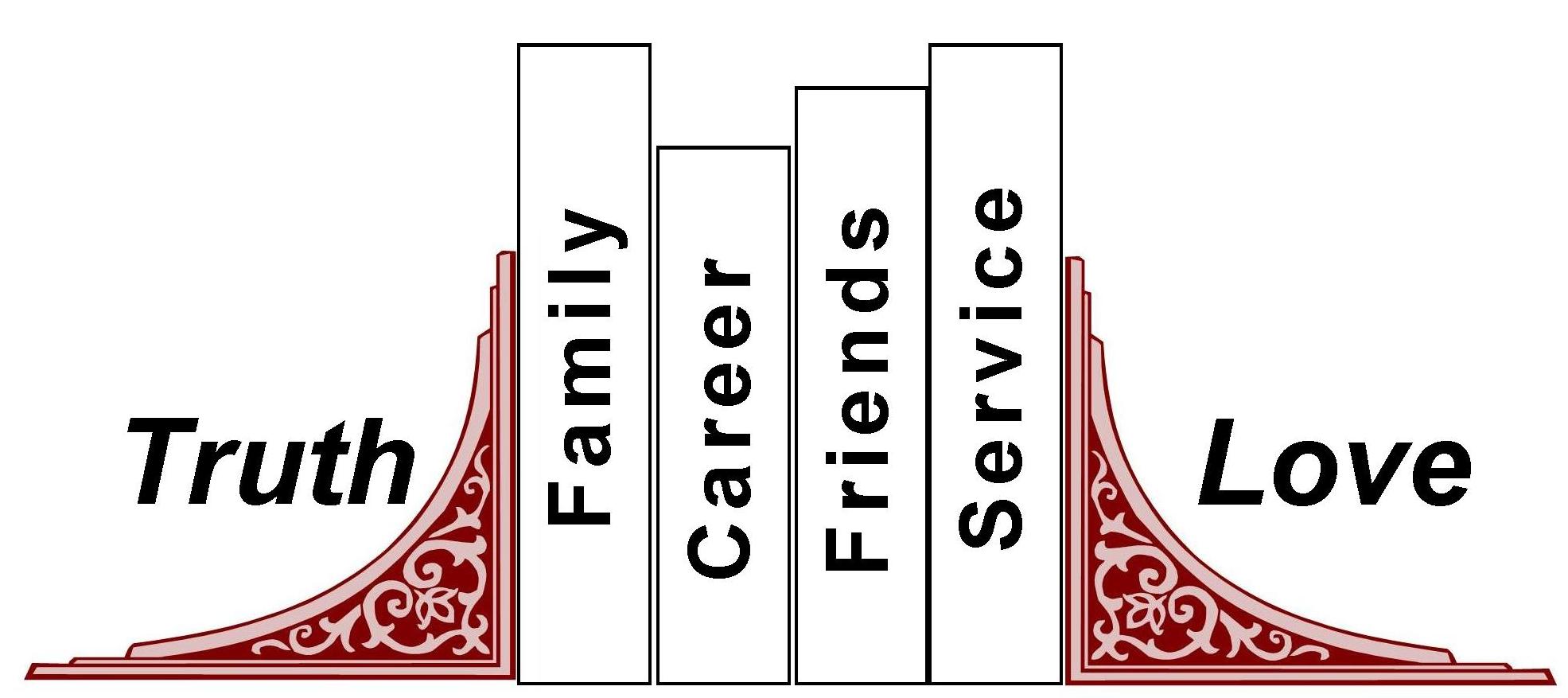
Life is full of pages and chapters. In the Christian life, we can be confident of two set boundaries established by God in His dealings with us – Truth & Love. They’re also to be our standards for personal interaction, which looks something like this…

I. Holy Spirit-to-me

With Jesus telling us in John 16:13 that the Holy Spirit will “guide us into all truth” and the declaration in I John 4:8 that “God is love”; I know He’s going to guide me that way. When the Holy Spirit is speaking to me, I’m confident He’ll always speak truth in love.

So how specifically does it happen? Well, I won’t attempt to define how God works, but I will mention three common things we know, but still resist at times:

  • Bible time – I need to get into His Word to read, listen, and contemplate.
  • Prayer – I need to communicate with Him (by the way, it’s a two-way conversation).
  • Obedience – I need to do what’s already been revealed to me, because I can’t expect further revelation if I’m ignoring what I already know.

II. Me-to-me

Paul instructs us in Ephesians 6:14 to gird our waist with truth. I remember in a former job (one of those previous chapters) when working in the warehouse, we were required to wear back support braces around our waist. It’s the same with truthfulness, it braces and supports. Without it come strain, injury, and painful recovery. We must be people of truth. However to be a person of truth, I must start by being truthful with myself.

I have to do as Jesus said and clean the speck out of my eye first before inspecting others. As I go through self-examination, I should remember the first point though. The Holy Spirit will guide me in truth and love. It’s not a time to get depressed, but a time to find victory. It often includes repentance, but with it comes liberty…precious liberty within the strength of a loving Savior!

III. Me-to-others

When reading I John 4:7-11, we see an “environment’ of love. John starts the passage with “Beloved, let us love one another…” and describes how authentic, self-less love is evidence of God’s presence in our lives and a direct reflection of Him. Speaking the truth sometimes isn’t the hard part; it’s the “in love” part that presents a challenge.

As tough as it is, we are mandated by scripture to live this way. It’s expected of me, as a follower of Christ, to live within the boundaries of truth and love:

  • In family life
  • In friendships
  • In career
  • In service to others

Ephesians 4:15 speaks of the benefits of truth spoken in love, and that’s maturity. It’s not always the easy path, but one definitely worth traveling. So put back the basket and grab a buggy…you’ll be glad you did!

Posted in Christian Life | Tagged , , , , , | Leave a comment

The Everyday Life

Over the years, the words of Oswald Chambers have greatly impacted me. For some reason, I feel compelled to share a quote I read this morning and a thought:

“We have a tendency to look for wonder in our experience, and we mistake heroic actions for real heroes. It is one thing to go through a crisis grandly, yet quite another to go through every day glorifying God when there is no witness, no limelight, and no one paying the remotest attention to us. If we are not looking for halos, we at least want something that will make people say, “What a wonderful man of prayer he is!” or “What a great woman of devotion she is!” If you are properly devoted to the Lord Jesus, you have reached the lofty height where no one would ever notice you personally. All that is noticed is the power of God coming through you all the time.”

                                                            – Oswald Chambers – “My Utmost for His Highest” Revised Edition

Thinking about it, I recall an early lesson I learned in the Army. It was simply to “do my duty.” Most of the time, the duty (even the cool stuff) wasn’t in sight of anyone. It wasn’t caught on camera, or followed up by an appreciative word, however, at the end of the day I could take pride in having been faithful to the call of service. It’s the same in my daily walk of faith as a Christ-follower. Sometimes God’s working may be visible or it may not be, however Ephesians 6:7 says to do everything “as to the Lord and not men.”

Maybe today as you journey through the Christian life your “backpack” is feeling heavy or the “trail” is getting steep – I encourage you to keep moving…please keep moving. Your fellow soldiers need you. Your family needs you, and lost people looking for hope need you. Remember to keep your eyes on Christ…consider His faithfulness…and soldier on!

For more info on Oswald Chambers and daily devotions, here’s a link: http://utmost.org/

Posted in Christian Life | Tagged , , , , | Leave a comment